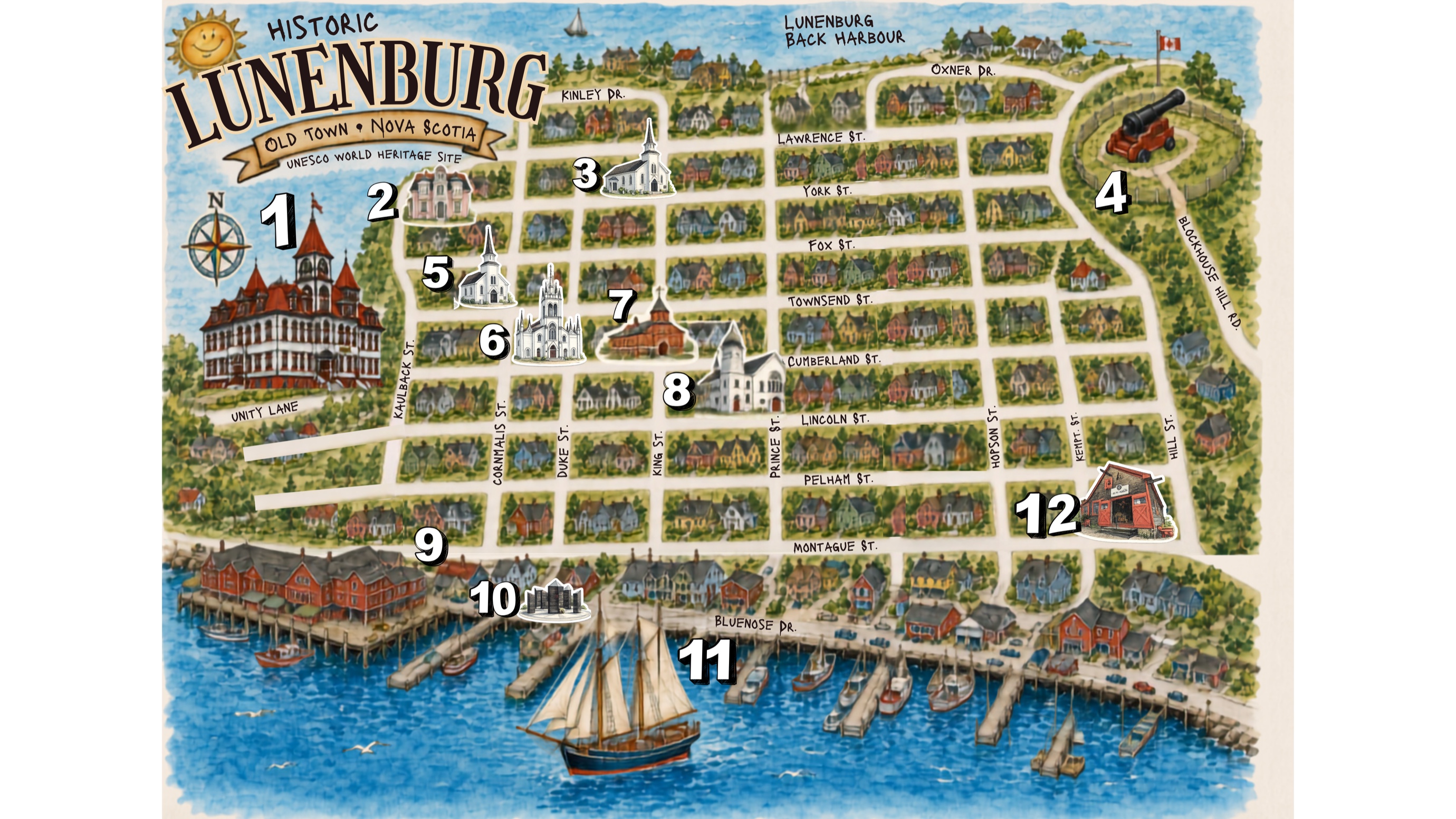
Illustrated orientation map — use the direction links for live navigation. The illustration is for interactive navigation and is not offered as a download.
Stop 1
Lunenburg Academy
Climb to the red-turreted landmark that watched over generations of schoolchildren.
Crowning Gallows Hill, the red-turreted Academy looks like a civic castle. Built in 1894–95, it served generations of students until 2012; turn toward the harbour to see how the old grid falls to the sea.
Admire the exuberant pink-and-white Morash house—quietly, from the public street.
This exuberant pink-and-white Victorian house dates from about 1888 and is associated with builder Solomon Morash. Its layers of trim inspired the ‘Wedding Cake’ nickname—and local devil-confusing folklore—but it remains a private home, so admire it quietly from the street.
Spot the witch’s-hat steeple on a modest 1839 Georgian church.
Built in 1839, St. Norbert’s is the verified historic name of this small wooden Georgian church. It became the centre of Lunenburg’s Roman Catholic community; the Canadian Register singles out its wonderfully witch’s-hat-shaped steeple.
Take in the harbour panorama from ground once chosen for the town’s defence.
Early Lunenburg was vulnerable, and defensive blockhouses once stood on this commanding hill. The buildings are gone, but the strategic panorama remains; today the Visitor Information Centre makes this the smartest place to begin before walking downhill.
Trace Lunenburg’s German-speaking roots in one of Canada’s oldest Lutheran congregations.
Zion’s congregation reaches back to Lunenburg’s founding era and the German-speaking Protestants among its first settlers. The present building is later, but its continuity, music and vivid red doors connect today’s town to those immigrant roots.
Enter one of Canada’s great community comeback stories, rebuilt after a devastating fire.
Founded with the town in 1753, St. John’s grew into this dramatic Carpenter Gothic landmark. A Halloween-night fire in 2001 nearly destroyed it; the community’s reconstruction became a remarkable comeback story, while the painted chancel stars continue to inspire a fascinating—but not certain—night-sky theory.
Pause where civic life, remembrance, music and public gathering meet.
This stop layers several forms of public memory: Town Hall, the war memorial, firefighters’ memorial and bandstand. Read the names, imagine ceremonies and summer music, and treat the memorials as places of remembrance rather than photo props.
See another chapter of the town’s many-denomination religious landscape.
Central United Church represents a later chapter in a town where congregations shaped music, care and daily life. Standing within minutes of Anglican, Lutheran and Catholic landmarks, it shows how several distinct communities shared one compact old town.
Board vessels, meet interpreters and understand the lives behind the postcard.
Here the harbour’s romance gains weight. Historic vessels, aquariums, exhibits and interpreters explain boatbuilding and offshore fishing—and the skill and danger of earning a living from the North Atlantic; allow at least ninety minutes and check seasonal access.
Read the cost of the sea in names, dates and vessels—not statistics.
This memorial turns ‘lost at sea’ into individual names, dates and vessels. Keep the harbour in view and pause quietly: it is the essential counterweight to Lunenburg’s postcard beauty and a reminder that many families waited without certainty or a grave.
Meet Nova Scotia’s sailing ambassador—and the schooner on Canada’s dime.
The original Bluenose was launched here in 1921, became a champion fishing schooner and racing legend, and lives on Canada’s dime. Bluenose II carries that story as Nova Scotia’s sailing ambassador; because she travels, check the 2026 schedule before promising yourself a sighting.
Taste small-batch spirits in an 1893 marine blacksmith’s shop by the harbour.
Ironworks occupies an 1893 marine blacksmith’s shop—a perfect bridge between the old industrial waterfront and Lunenburg’s creative present. Adults can ask about small-batch tastings; everyone can appreciate how a historic working building has found a new working life.